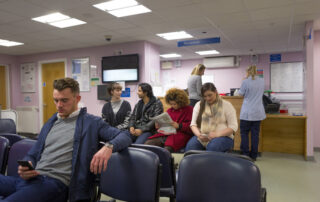

Nearly 1 in 5 UK emergency department patients cared for in corridors/waiting rooms

Almost all emergency departments routinely deploying this approach At any one time, nearly 1 in 5 emergency department patients in the UK is being cared for in corridors, waiting rooms, and other non-standard ‘overflow’ spaces—an approach known as escalation area care—suggest the results of a large observational study, published online ...

2025-12-11T09:35:51+00:0011 December 2025|Emergency Medicine Journal, Press release|

Telling women as part of mammography screening that they have dense breasts may have unintended effects

Leaves some women anxious and confused about their breast health and may increase demand on health services, say researchers Recommendations introduced in Australia and being considered in the UK to tell women if they have dense breasts as part of their screening results may have unintended effects and increase demand on ...

2025-12-04T10:10:13+00:004 December 2025|Press release, The BMJ|

Eating disorders in mums-to-be linked to heightened risk of asthma and wheezing in their kids

No significant variation in risk by type of disorder or timing of child’s exposure Include dedicated support for these disorders in maternal healthcare, say researchers Eating disorders in mums-to-be are linked to a heightened risk of asthma and wheezing in their children, irrespective of the type of disorder, presence of ...

2025-12-03T11:03:02+00:003 December 2025|Press release, Thorax|

Overreliance on AI risks eroding new and future doctors’ critical thinking while reinforcing existing bias

Tools already widely used amid few institutional policies and regulatory guidance Medical education must adjust curricula + training to mitigate risks, warn experts Overreliance on generative AI risks eroding new and future doctors’ critical thinking skills, while potentially reinforcing existing data bias and inequity, warns an editorial published in the ...

2025-12-03T10:36:01+00:003 December 2025|BMJ Evidence Based Medicine, Press release|

Gender-specific supportive environment key to cutting female athletes’ injury risks

Among other things, this should be free of body shaming, idealised body types, and gendered norms, says the world’s first Consensus Statement on this topic Creating a safe, gender-specific, supportive environment—one that is free of body shaming and idealised female forms, for example—is key to minimising female athletes’ future risks ...

Daily coffee drinking may slow biological ageing of people with major mental illness

Major psychiatric disorders associated with shorter telomeres, indicative of cellular ageing 3-4 cups linked to longer telomeres, equal to 5 extra ‘biological’ years, say researchers But no such effects observed beyond this daily amount Drinking a maximum of 3-4 cups of coffee a day may slow the ‘biological’ ageing of ...

2025-11-26T09:38:12+00:0026 November 2025|BMJ Mental Health, Press release|
Go to Top