
From clinical observation to food safety policy
Research published in Archives of Disease in Childhood identified a serious and previously underrecognised risk associated with slush ice drinks marketed to children, directly influencing food safety guidance and regulatory discussions across the UK, Ireland, Germany, and the European Union.
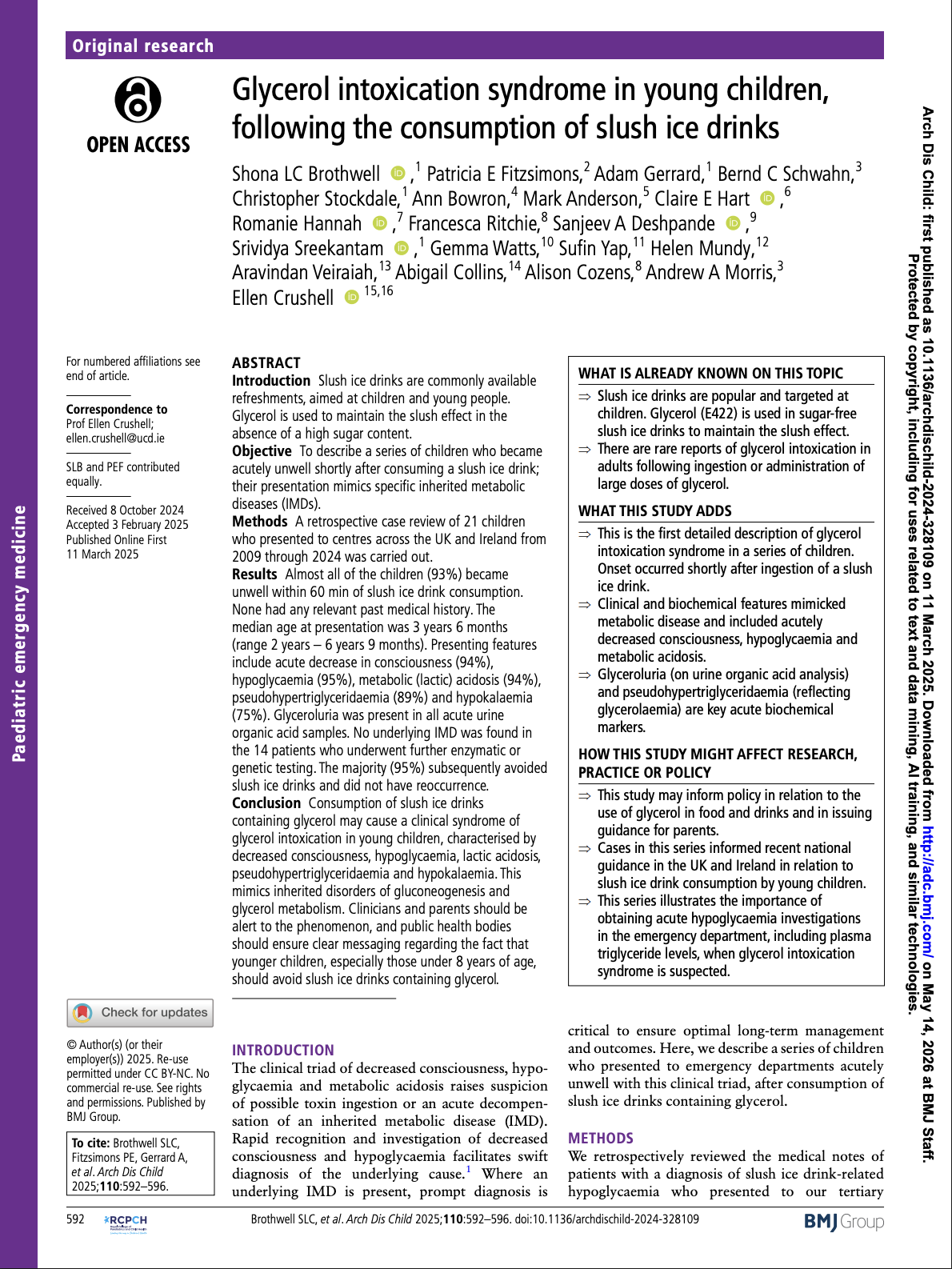
The study, ‘Glycerol intoxication syndrome in young children, following the consumption of slush ice drinks’, ¹ demonstrated that glycerol, increasingly used in sugar-free slush ice drinks following the introduction of sugar-sweetened beverage levies in Ireland and the UK, can cause acute severe illness in young children.
Manufacturers had replaced sugar with glycerol (E422), which has useful properties to maintain the slush effect while reducing sugar content. The research defined ‘glycerol intoxication syndrome’ in children for the first time and provided evidence that rapidly informed food safety guidance in the UK and Ireland, while also contributing to wider European regulatory discussions. In 2026, the European Food Safety Authority recommended that the European Commission consider establishing numerical maximum levels for glycerol in beverages.
The research
The multicentre study investigated 21 children aged between 2 and 7 years who became seriously unwell shortly after drinking slush ice drinks. Most became drowsy or lost consciousness, and developed dangerously low blood sugar and a build-up of acid in the blood. The symptoms were so severe that they initially resembled rare inherited metabolic conditions. All children were admitted to hospital for treatment, but none were found to have an underlying metabolic disorder, and all recovered fully.
Researchers found clear evidence that the children had consumed high amounts of glycerol, a widely used sweetener increasingly used in large amounts in sugar-free slush drinks due to its antifreeze properties.
The study was the first to describe “glycerol intoxication syndrome” in children and the first published research linking the condition to slush ice drinks.
The impact
The research rapidly influenced food safety policy and clinical guidance. In recognition of its wider public health and policy impact, the study researchers subsequently received the University College Dublin Research Impact Award and Policy Impact Award in January 2026. ²
- In the UK, the Food Standards Agency undertook a rapid risk assessment and revised national guidance in 2025, recommending that children under 7 should not consume slush ice drinks containing glycerol and that older children should limit their intake. ³ Food Standards Scotland subsequently issued updated guidance for retailers and industry to support implementation of the new recommendations.⁴
- The Food Safety Authority of Ireland had been alerted during the research by the authors and raised concerns about glycerol exposure in children, and contributed to wider European discussions on slush ice drinks containing glycerol. At the end of May 2026, following EFSA guidance, the FSAI changed its policy to recommend no glycerol-containing slushies for children aged 10 years and younger.
- Germany’s Federal Institute for Risk Assessment (BfR) undertook a health risk assessment concluding that glycerol-containing slush ice drinks can contain widely variable glycerol concentrations and may pose a health risk to children.⁵ BfR subsequently published an FAQ that explicitly cites the ADC study, noting 21 reported cases of children presenting with symptoms after consuming slush ice drinks in the UK and Ireland between 2009 and 2024.⁶
- The study additionally improved clinical awareness. According to the author, glycerol intoxication was included in TOXBASE, while the Royal College of Emergency Medicine issued safety guidance for emergency departments.
- The European Food Safety Authority (EFSA) published a new scientific opinion referencing the study, which included the recommendation for the European Commission to consider establishing numerical maximum levels for glycerol (E 422) when used in beverages.⁷
- The paper attracted substantial international media attention and public engagement, with more than 29,000 full-text downloads within six months of publication.

“We identified a severe illness pattern in children linked to glycerol, increasingly used in slush ice drinks. Publishing the research in the Archives of Disease in Childhood helped the evidence reach clinicians, toxicologists, food safety authorities, and policymakers.”
Ellen Crushell
Clinical professor, School of Medicine, University College Dublin; consultant paediatrician in inherited metabolic disorders at Children’s Health Ireland (CHI); deputy chief medical officer, Department of Health, Ireland
About the Archives of Childhood Disease in Childhood
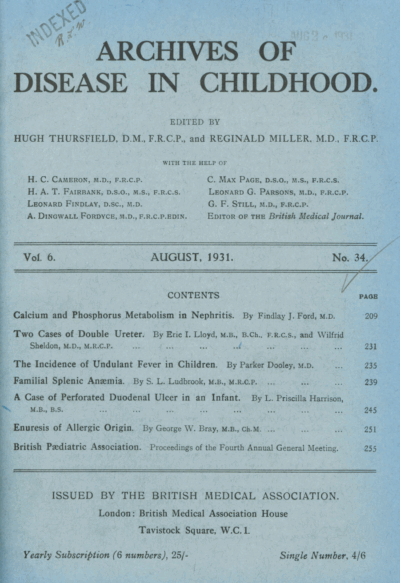
Published by BMJ Group in partnership with the Royal College of Paediatrics and Child Health, Archives of Disease in Childhood (ADC) is a leading international peer reviewed journal covering child health from the perinatal period through to adolescence. The journal publishes original research, reviews, commentaries and evidence-based guidance to support paediatric clinical practice, policy and education worldwide.
First published in 1926 as the British Medical Association’s first specialty journal, ADC remains a leading title today. In 2024, its publications provided key evidence that informed the Cass Review, a landmark report on gender dysphoria.
Related posts
-
 From research to legislation: improving allergy safety in schools
 -
 Driving global health research through BMJ collections
 -
 Advancing global healthcare resilience
 -
 BMJ Investigations Unit empowers councils to challenge fast food planning decisions
