
New BMJ Collection calls for evidence based and sustainable mental health support in conflict settings
A new collection on Child Mental Health in Conflict Settings published by The BMJ, in partnership with the World Innovation Summit for Health (WISH), calls for evidence based, scalable, sustainable, and long term interventions to be integrated into existing health, education, and social systems, as well as renewed global commitment and funding to protect the mental health of children affected by war.
Amid rising geopolitical tensions and declining global cooperation, armed conflict is at its highest levels since the second world war.
One in five children worldwide live in conflict affected settings, including Gaza, Ukraine, Myanmar, and Sudan. Aside from physical dangers, living in such settings exposes children to multiple, accumulating, intergenerational risks to mental health.
Yet less than 1% of development aid is allocated to mental health, and many children in these settings lack access to evidence based psychosocial support interventions.
The collection consists of three Analysis articles, which outline the high levels of mental health problems children living in conflict settings face, both directly and indirectly as a result of violence.
In the accompanying editorial Etheldreda Nakimuli-Mpungu and colleagues argue that in order to effectively address child mental health, interventions must prioritise caregiver wellbeing and support for families, which in turn can lead to better child mental health outcomes.
They support calls for an evidence based approach to implementing and scaling up interventions. This includes choosing interventions to reduce stigma, strengthen caregiver support, tackle symptoms, and routinely using implementation studies to identify the best approach for each context.
With long term funding and global leadership, children’s mental health support could be integrated into existing routine services, overcoming current fragmented humanitarian responses, they argue.
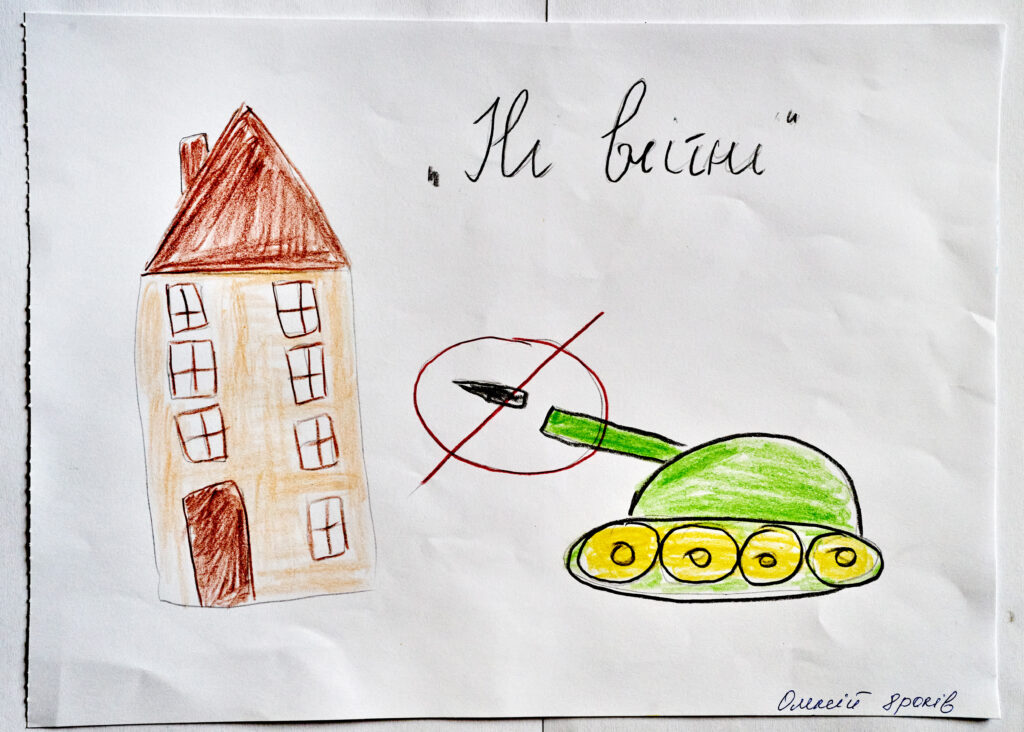
Kotlyarev, Mykolaiv, Ukraine
A drawing by eight-year-old Oleksii from Kotlyarev which depicts a tank and the text “No War”
Credit: Panos

“These reforms support a shift from scaling faster to scaling more carefully, by aligning how interventions are designed, delivered, and funded with what actually drives children’s mental health in conflict settings.”
Etheldreda Nakimuli-Mpungu
Associate Professor, London School of Hygiene and Tropical Medicine, UK
Articles in the BMJ Collection on Child Mental Health in Conflict Settings
Editorial
Child and caregiver mental health in conflict affected settings
Etheldreda Nakimuli-Mpungu
Analysis
Long term effects of childhood exposure to violence in fragile and conflict affected settings
Zulfiqar A Bhutta
Analysis
Evidence based mental health interventions for children in fragile and conflict affected settings: expanding reach and system strengthening
Theresa S Betancourt
Analysis
Integrating child mental health responses into recovery, development, and peacebuilding in fragile and conflict affected settings
Zulfiqar A Bhutta
Notes to editors
Collection landing page: https://www.bmj.com/collections/child-mental-health
Contact: Richard Hurley, Collections Editor, The BMJ, mediarelations@bmj.com
About BMJ Group and BMJ Collections
BMJ Group is a global healthcare knowledge provider and publisher of one of the world’s top five most cited general medical journals, The BMJ. For BMJ Group, collections are an important way of bringing evidence together to address key issues in health and research. BMJ Collections help inform policy and guidelines and influence funding decisions by tackling the most pressing health challenges, policy issues and global priorities.
They combine research, analysis and expert commentary, coordinated and commissioned through our global network of researchers, and are developed with academic institutions, funders, non governmental organisations and international bodies. Drawing on leading journals such as The BMJ, BMJ Innovations and BMJ Global Health, they raise awareness and deliver the latest, most relevant evidence through events, targeted dissemination and thought leadership. https://www.bmj.com/collections
About WISH
A global health community dedicated to capturing and disseminating the best evidence-based ideas and practices. WISH is an initiative of Qatar Foundation for Education, Science and Community Development (QF) and is under the patronage of Her Highness Sheikha Moza bint Nasser, its Chairperson.
You can find more about the BMJ Group-WISH partnership here: https://bmjgroup.com/humanising-health-conflict-equity-and-resilience/
Related posts
-
 Further evidence of developmental risks linked to epilepsy drugs in pregnancy
 -
 New brain stimulation technique improves short term social skills in children with autism
 -
 Addressing inequality in post-partum haemorrhage
 -
 Rates of autism in girls and boys may be more equal than previously thought
