
Strengthening the case for Benedict’s Law through evidence and advocacy
Research in Archives of Disease in Childhood (ADC), published by BMJ Group, has helped inform national policy on child safety and contributed to progress in achieving Benedict’s Law, a set of national protections designed to improve allergy safety in schools.
Led by paediatric allergy specialist Paul Turner, the published cohort study examined how schools prepare for severe allergic reactions. It showed that the current system, where children carry individual adrenaline auto-injectors, is both inefficient and costly. During the 2023–24 academic year, 63% of pupils were prescribed more than two devices, contributing to an estimated national cost of over £9m.
The research demonstrated that a government funded, school-based model could provide universal access to emergency treatment for around £4.5m, representing a saving of at least £4.6m, or 25% of total national expenditure on adrenaline auto-injectors. By combining clinical data with clear economic modelling, the study produced evidence that has directly informed policy discussions.
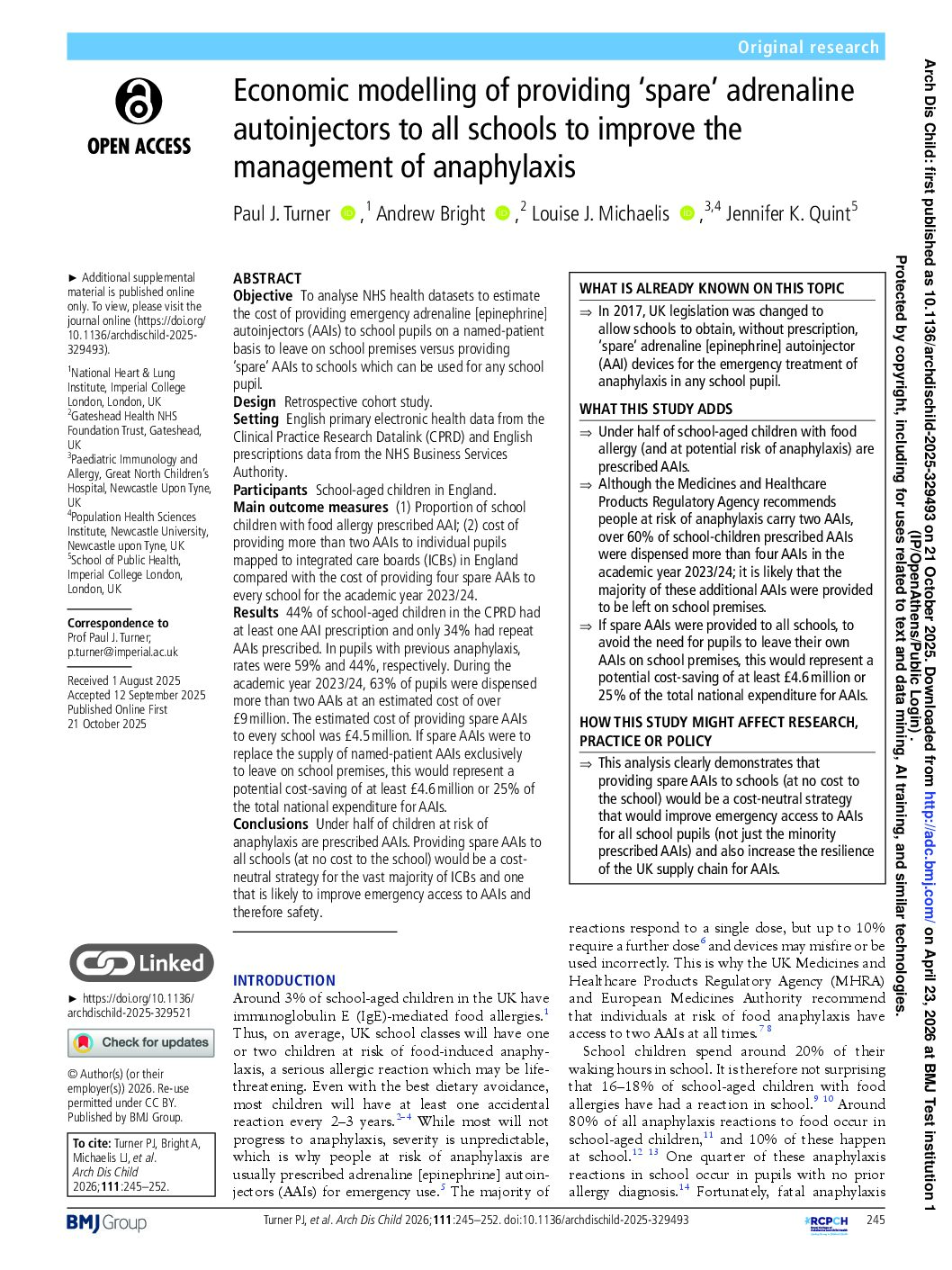
This evidence aligned with the work of the Benedict Blythe Foundation. Established following the death of five-year-old Benedict Blythe, the Foundation has worked to ensure no child is left without access to life saving treatment at school. Its campaigning brought national attention and engagement in Parliament, and Benedict’s mother, Helen co-authored an accompanying editorial. ‘Spare pens save lives-so why aren’t they in every school?’ That evidence together with research from the Foundation provides a clear and robust basis for change.
The study findings were cited in UK Parliament, where they supported the case for reform. The analysis helped reframe the issue as improving safety need not increase cost. It did this by clearly demonstrating how universal access to emergency treatment can be achieved by replacing excess individual prescribing with a centralised school-based approach. If implemented nationally, this model would apply across all UK schools.
With legislation progressing and statutory guidance confirmed for implementation from September 2026, this case shows how research in Archives of Disease in Childhood can inform debate beyond academia. It promotes advocacy, informs policy decisions at national scale, and contributes to safer care for children.

“The research published in Archives of Disease in Childhood has provided additional gravitas to the evidence that improving safety from anaphylaxis in school children is achievable without necessarily increasing costs.”
Paul Turner
Professor of anaphylaxis, paediatric allergy and clinical immunology, Imperial College London, UK
Impact at a glance
- Cited in UK Parliament
Evidence from Archives of Disease in Childhood used in Hansard directly supported legislative debate - Informed national legislation
Contributed to progress toward Benedict’s Law and allergy safety requirements in schools - Supporting emerging statutory guidance
- Evidence base supporting new government guidance for schools, expected from September 2026, on allergy safety and emergency response
- Shifted policy framing
Reframed the issue from an additional cost to a cost neutral or cost saving intervention - Quantified economic impact
Identified ≥£4.6m annual savings (≈25% reduction in national spend)

This research was funded by the UK Medical Research Council (reference MR/W018616/1) and the UK Food Standards Agency (reference FS101222). The funders had no role in considering the study design or in the collection, analysis, interpretation of data, writing of the report, or decision to submit the article for publication
Further guidance for schools on managing allergies and emergency response is available via UK Government allergy guidance for schools, supporting implementation in practice.
First founded in 1926, Archives of Disease in Childhood has a long track record in paediatrics. It is endorsed by the Royal College of Paediatrics and Child Health for Continued Professional Development in line with RCPCH CPD guidelines.
Related posts
-
 The impact of patient advocacy on peer review
 -
 Driving global health research through BMJ collections
 -
 Raising awareness of a rare but serious risk linked to menstrual cup use
 -
 BMJ Group unveils 2025 impact report, spotlighting global health influence and policy reach
